
New UH Medical Facility in Middlefield Could Expand Access for Local and Amish Families
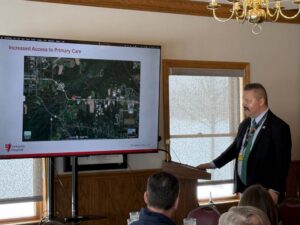
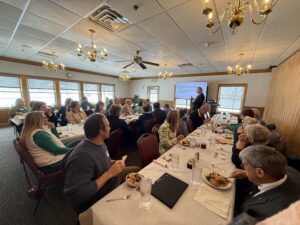
At the Middlefield Chamber of Commerce meeting held March 17 at noon at Mary Yoder’s Amish Kitchen, Dr. Jonathan C. Sague shared an encouraging vision for the future of healthcare in Middlefield, with a strong focus on expanded access, local care, and meeting the needs of the Amish community. Also adding perspective to the discussion was Mayor Ben Garlich, who spoke about the village’s role in helping make the proposed new facility a reality.
Dr. Sague, a Geauga County native raised in Burton and Munson Township, spoke not only as a healthcare executive, but as someone deeply connected to the area. He began his career at just 13 years old as a fire cadet and later became a firefighter-paramedic. Today, he serves as Chief Operating Officer for University Hospitals’ East Market, overseeing UH Geauga, Conneaut, and Geneva Medical Centers, while continuing to serve part-time with the Chardon Fire Department.
During his presentation, Dr. Sague addressed the growing need for primary care access in the Middlefield area and explained that University Hospitals is actively working toward a new medical facility in the former BFG building acquired by the Village of Middlefield.
He said the need is clear. Practices in Middlefield are not able to absorb the demand, and the number of people seeking appointments continues to grow. According to Sague, calls from people wanting to become new patients, along with calls from those needing same-day care for illness or injury, had already topped 1,000 in each category during part of the year being measured. That demand, he said, shows that more access is urgently needed.
To help solve that problem, University Hospitals has been studying the BFG building as a possible home for an expanded healthcare center. Sague explained that UH is already paying for architectural and feasibility work to determine what the space could become, what parts of the building can be used, what must be added, and what the overall cost may be.
Mayor Ben Garlich added that the village purchased the building with two major purposes in mind: water infrastructure and a medical center. He explained that the community’s investment in the building was made with local needs in mind and that village leaders want to see the property serve residents in a practical, lasting way. Garlich said his goal is to structure the project so it is fair both to taxpayers, who supported the acquisition of the building, and to University Hospitals as a nonprofit healthcare partner bringing services into the community.
He noted that the exact financial details still depend on the final scope and cost of the project, but emphasized that the village is committed to working toward a solution that protects public investment while making the medical facility possible. His remarks underscored that the proposed center is not simply a healthcare project, but a collaboration between local government and a major regional health system.
Sague described the project as a community-driven effort involving UH, the mayor, the village, Amish Leaders and surrounding townships. He said progress is being made, even if not as quickly as anyone would like, and expressed confidence that the project is moving in the right direction.
He said the goal is not simply to create a small doctor’s office, but a facility designed for long-term growth. He emphasized that the space should not be too small on opening day and that it should allow room for additional services and specialists over time. The plans under consideration include use of the building’s mezzanine space so the center can grow into the future rather than outgrow the site immediately.
Among the services discussed for the future Middlefield site was a walk-in illness and injury clinic. Dr. Sague explained that this would be more advanced than a standard urgent care. The model he described would allow patients with non-life-threatening but immediate needs to be seen locally, treated promptly, and kept out of the emergency department when hospital-level emergency care is not necessary. He gave examples such as cuts, injuries, casting broken bones that are not displaced, and other conditions that need quick attention but not a 911 response.
Just as important as the building itself was Dr. Sague’s emphasis on serving the Amish community well.
He shared that University Hospitals already has an Amish nurse navigator, Kara, who works through the community outreach program and EMS Institute. Her role includes helping Amish patients and families navigate care, answering questions, coordinating support, and even making home visits when appropriate. During COVID, he noted, UH also used non-emergency ambulance support and other outreach tools to meet people where they were.
Sague made it clear that the Amish community is not an afterthought in this project. Rather, it is central to the planning. He spoke about the importance of creating a facility and a model of care that is both accessible and practical for Amish families. He also addressed the need for pricing that remains fair and manageable for self-pay patients, saying UH is actively working to ensure costs do not become a barrier to care.
Several audience members raised questions about healthcare access for Amish residents, including transportation, affordability, specialist access, and the high rate of serious illness seen in the community. Sague acknowledged those concerns thoughtfully and stressed that earlier access to primary care, screening, specialists, and education can make a major difference. He noted that this proposed Middlefield site could eventually host not just primary care, but visiting specialists as well, creating opportunities for services that are difficult to access now.
He also said that certified nurse midwives and specialty providers could potentially rotate through the space on scheduled days, giving local families and Amish patients access to more care without long-distance travel. He described the concept as something innovative that could serve as a model for other rural communities across the country if it is done well.
Mayor Garlich’s comments reinforced that the project is important not only because of the services it would bring, but because it reflects a larger commitment by the village to invest in Middlefield’s future. Chamber members heard clearly that this is a project requiring patience, planning, and partnership, but one that local leaders believe is worth the effort.
Throughout the luncheon, Dr. Sague’s message was grounded in both practicality and personal investment. He spoke candidly about the challenges of healthcare today, but he returned repeatedly to one point: Middlefield needs more access to care, and he sees it as his responsibility to help create it.
For the Chamber audience, the presentation offered not just information, but optimism. The proposed BFG facility represents more than a building project. It represents a collaborative effort between University Hospitals, the Village of Middlefield, and the broader community to bring meaningful, accessible healthcare closer to home for area residents and for the Amish community that is such an important part of the region.
If completed as envisioned, the project could become one of the most significant local healthcare developments in years.